
The Rise and Spread Christianity in the Roman Empire
Cloze Test Worksheet
Kindly Shared By:

Date Shared: 8 November 2026
Worksheet Type:
Tags Describing Content or Audience:
Worksheet Instructions:
Student Task. Listen carefully as your teacher reads the paragraph about how the Roman army was organized during the first two centuries of the Roman Empire.
Target Language or Knowledge:
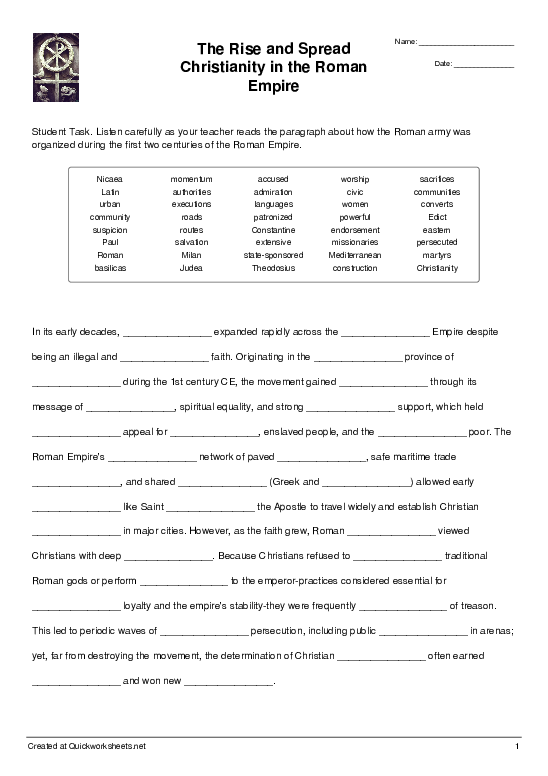
In its early decades, Christianity expanded rapidly across the Roman Empire despite being an illegal and persecuted faith. Originating in the eastern province of Judea during the 1st century CE, the movement gained momentum through its message of salvation, spiritual equality, and strong community support, which held powerful appeal for women, enslaved people, and the urban poor. The Roman Empire’s extensive network of paved roads, safe maritime trade routes, and shared languages (Greek and Latin) allowed early missionaries like Saint Paul the Apostle to travel widely and establish Christian communities in major cities. However, as the faith grew, Roman authorities viewed Christians with deep suspicion. Because Christians refused to worship traditional Roman gods or perform sacrifices to the emperor—practices considered essential for civic loyalty and the empire's stability—they were frequently accused of treason. This led to periodic waves of state-sponsored persecution, including public executions in arenas; yet, far from destroying the movement, the determination of Christian martyrs often earned admiration and won new converts.
The major turning point for Christianity came in the early fourth century through the actions of Emperor Constantine. Prior to a key battle in 312 CE, Constantine reportedly experienced a vision of a Christian symbol and, after achieving victory, attributed his success to the Christian God. In 313 CE, he issued the Edict of Milan, which officially legalized Christianity and ended centuries of religious persecution across the empire. Constantine actively patronized the Church by donating land, funding the construction of grand public basilicas, exempting clergy from taxes, and convening the Council of Nicaea in 325 CE to resolve doctrinal disputes. His endorsement elevated Christianity from a marginalized sect into a favored social institution. By 380 CE, under Emperor Theodosius I, Christianity was declared the sole official state religion of the Roman Empire, completing its transformation into the dominant cultural and political force of the Mediterranean world.
Christianity Roman persecuted eastern Judea momentum salvation community powerful women urban extensive roads routes languages Latin missionaries Paul communities authorities suspicion worship sacrifices civic accused state-sponsored executions martyrs admiration converts Constantine Edict Milan patronized construction basilicas Nicaea endorsement Theodosius Mediterranean
QUESTIONS: Which groups of people were attracted to early Christianity, and how did Roman roads and languages help missionaries spread the faith?
Discussion Be the first to comment about this worksheet.
Please log in to post a comment.

 Download Worksheet

 Continue with Google
To claim that this member-shared worksheet infringes upon your copyright please read these instructions on submitting a takedown request.


8 November 2026
jbower Author