
RUSSIAN REVOLUTION: GLOSSARY
Matching Pairs Worksheet
Kindly Shared By:
Date Shared: 26 June 2025
Worksheet Type:
Tags Describing Content or Audience:
Worksheet Instructions:
None provided.
Target Language or Knowledge:
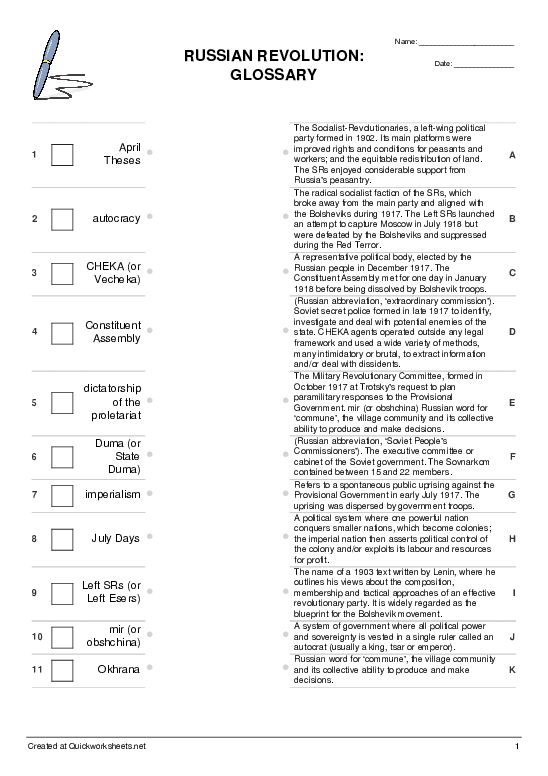
April Theses The April Theses was a document published by Lenin shortly after his return to Russia from exile in 1917. It insisted that no support be given to the Provisional Government, calling for an immediate end to Russia’s involvement in World War I and for socialist revolution as soon as possible autocracy A system of government where all political power and sovereignty is vested in a single ruler called an autocrat (usually a king, tsar or emperor). CHEKA (or Vecheka) (Russian abbreviation, ‘extraordinary commission’). Soviet secret police formed in late 1917 to identify, investigate and deal with potential enemies of the state. CHEKA agents operated outside any legal framework and used a wide variety of methods, many intimidatory or brutal, to extract information and/or deal with dissidents. Constituent Assembly A representative political body, elected by the Russian people in December 1917. The Constituent Assembly met for one day in January 1918 before being dissolved by Bolshevik troops. dictatorship of the proletariat A term describing the political system anticipated after a socialist revolution. Representatives of the proletariat (working classes) would assume control of the government, eradicate democracy and make decisions to benefit the workers. Duma (or State Duma) (Russian, ‘thinkers’). The national parliament of Russia between 1906 and 1917. The Duma was formed by Tsar Nicholas II in the wake of the 1905 Revolution, however it exerted little political influence during its life. imperialism A political system where one powerful nation conquers smaller nations, which become colonies; the imperial nation then asserts political control of the colony and/or exploits its labour and resources for profit. July Days Refers to a spontaneous public uprising against the Provisional Government in early July 1917. The uprising was dispersed by government troops. Left SRs (or Left Esers) The radical socialist faction of the SRs, which broke away from the main party and aligned with the Bolsheviks during 1917. The Left SRs launched an attempt to capture Moscow in July 1918 but were defeated by the Bolsheviks and suppressed during the Red Terror. mir (or obshchina) Russian word for ‘commune’, the village community and its collective ability to produce and make decisions. Okhrana (Russian, ‘guards’). The tsarist secret police force, created in 1881 by restructuring the Third Section. The Okhrana was primarily concerned with state security and the personal safety of the tsar, mainly by identifying and bringing to justice dangerous revolutionary, anarchist or terrorist groups. Milrevcom (or MRC) The Military Revolutionary Committee, formed in October 1917 at Trotsky’s request to plan paramilitary responses to the Provisional Government. mir (or obshchina) Russian word for ‘commune’, the village community and its collective ability to produce and make decisions. Sovnarkom (Russian abbreviation, ‘Soviet People’s Commissioners’). The executive committee or cabinet of the Soviet government. The Sovnarkom contained between 15 and 22 members. SRs (or Esers) The Socialist-Revolutionaries, a left-wing political party formed in 1902. Its main platforms were improved rights and conditions for peasants and workers; and the equitable redistribution of land. The SRs enjoyed considerable support from Russia’s peasantry. Stolypin’s necktie A colloquial term for the hangman’s noose, the use of which was expanded considerably during the prime ministership of Petr Stolypin (1906-1911). Trudoviks (Russian, ‘workers’). A socialist party active in Russian politics between 1905 and 1917. The Trudoviks were a breakaway faction of the SRs who won large numbers of seats in the first two State Dumas, one of whom was Alexander Kerensky. war communism The name given to the Bolshevik economic policy imposed during the Russian Civil War (1918-21). War communism sought to supply the war effort with compulsory grain What is to Be Done? The name of a 1903 text written by Lenin, where he outlines his views about the composition, membership and tactical approaches of an effective revolutionary party. It is widely regarded as the blueprint for the Bolshevik movement. zemstvo (plural, zemstva) A representative local council. The zemstva were established by Alexander II in 1864 and given the legal authority to make local improvements in education, healthcare and social policy. Most zemstva were dominated by conservative or liberal nobles so were mildly reformist but not revolutionary. Soviet Order Number One A council of working class delegates, each selected to represent their work unit (for example, a factory, mine or military unit). The Petrograd Soviet, formed in March 1917, was the largest and most significant of the 3,000 or so soviets across Russia.
Discussion Be the first to comment about this worksheet.
Please log in to post a comment.

 Download Worksheet

 Continue with Google
To claim that this member-shared worksheet infringes upon your copyright please read these instructions on submitting a takedown request.


26 June 2025
consarr Author