
AIS 2025-2026 Grammar Final Exam
Multiple Choice Worksheet
Kindly Shared By:

Date Shared: 20 May 2026
Worksheet Type:
Tags Describing Content or Audience:
Worksheet Instructions:
None provided.
Target Language or Knowledge:
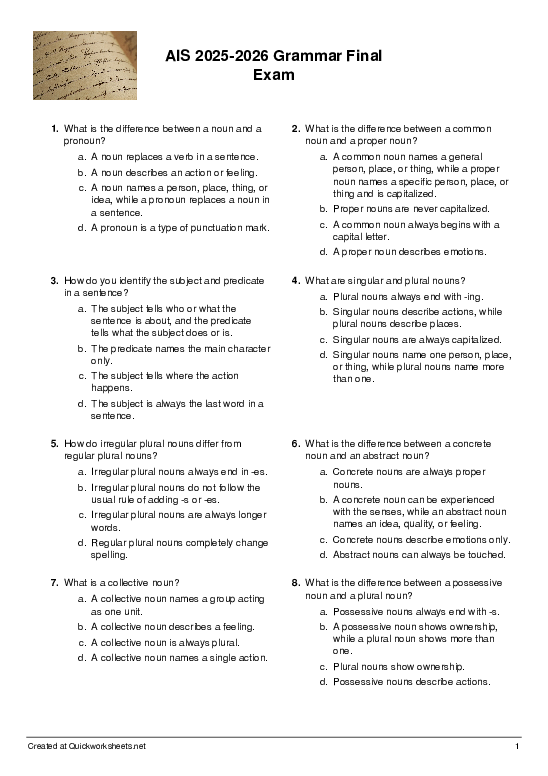
What is the difference between a noun and a pronoun?
What is the difference between a common noun and a proper noun?
How do you identify the subject and predicate in a sentence?
What are singular and plural nouns?
How do irregular plural nouns differ from regular plural nouns?
What is the difference between a concrete noun and an abstract noun?
What is a collective noun?
What is the difference between a possessive noun and a plural noun?
What are personal pronouns?
What is the difference between intensive and reflexive pronouns?
What are subject pronouns and object pronouns?
What is an antecedent?
Why must pronouns agree with their antecedents?
What is a verb?
What is the difference between an action verb and a linking verb?
What is a helping verb?
What is the difference between a transitive verb and an intransitive verb?
What is a direct object?
What is an indirect object?
What is subject-verb agreement?
Why is verb tense consistency important in writing?
What is the difference between past, present, and future tense?
What are the principal parts of a verb?
What is an adjective?
What is the difference between an adjective and an adverb?
What are comparative and superlative adjectives?
What is an adverb, and what questions does it answer?
What is a preposition?
What is a prepositional phrase?
What is a conjunction?
What is the difference between coordinating and subordinating conjunctions?
What is an interjection?
What is a phrase?
What is a clause?
What is the difference between an independent clause and a dependent clause?
What is a simple sentence?
What is a compound sentence?
What is a complex sentence?
What is a compound-complex sentence?
What is a run-on sentence?
What is a sentence fragment?
When should commas be used in a sentence?
What is the purpose of semicolons?
When should quotation marks be used?
What is capitalization, and why is it important?
What are the rules for using apostrophes?
What is parallel structure in writing?
Why is punctuation important for meaning and clarity?
What is the difference between formal and informal language?
Why is strong grammar important in speaking and writing?
A noun names a person, place, thing, or idea, while a pronoun replaces a noun in a sentence.
A noun replaces a verb in a sentence.
A pronoun is a type of punctuation mark.
A noun describes an action or feeling.
A common noun names a general person, place, or thing, while a proper noun names a specific person, place, or thing and is capitalized.
A common noun always begins with a capital letter.
A proper noun describes emotions.
Proper nouns are never capitalized.
The subject tells who or what the sentence is about, and the predicate tells what the subject does or is.
The subject tells where the action happens.
The predicate names the main character only.
The subject is always the last word in a sentence.
Singular nouns name one person, place, or thing, while plural nouns name more than one.
Singular nouns describe actions, while plural nouns describe places.
Plural nouns always end with -ing.
Singular nouns are always capitalized.
Irregular plural nouns do not follow the usual rule of adding -s or -es.
Regular plural nouns completely change spelling.
Irregular plural nouns always end in -es.
Irregular plural nouns are always longer words.
A concrete noun can be experienced with the senses, while an abstract noun names an idea, quality, or feeling.
Concrete nouns describe emotions only.
Abstract nouns can always be touched.
Concrete nouns are always proper nouns.
A collective noun names a group acting as one unit.
A collective noun names a single action.
A collective noun describes a feeling.
A collective noun is always plural.
A possessive noun shows ownership, while a plural noun shows more than one.
Possessive nouns describe actions.
Plural nouns show ownership.
Possessive nouns always end with -s.
Personal pronouns are words that replace specific people or things, such as he, she, it, and they.
Personal pronouns describe nouns.
Personal pronouns connect sentences together.
Personal pronouns are always action words.
Intensive pronouns emphasize a noun or pronoun, while reflexive pronouns refer back to the subject.
Intensive pronouns always begin sentences.
Reflexive pronouns describe emotions.
Intensive pronouns replace verbs.
Subject pronouns perform the action, while object pronouns receive the action.
Subject pronouns receive the action.
Object pronouns perform the action.
Subject pronouns describe locations.
An antecedent is the noun or pronoun to which another pronoun refers.
An antecedent is a punctuation mark.
An antecedent is a type of verb tense.
An antecedent is another word for adjective.
Pronouns must agree with their antecedents in number and gender for clarity and correctness.
Pronouns must agree with verbs only.
Agreement makes sentences shorter.
Pronouns agree with punctuation marks.
A verb is a word that expresses action or a state of being.
A verb is a word that names a person or place.
A verb is a type of conjunction.
A verb describes only colors.
An action verb shows action, while a linking verb connects the subject to additional information.
Action verbs connect subjects to nouns only.
Linking verbs always show movement.
Action verbs replace adjectives.
A helping verb works with the main verb to show tense, mood, or voice.
Helping verbs replace nouns in sentences.
Helping verbs describe emotions.
Helping verbs connect two independent clauses.
A transitive verb has a direct object, while an intransitive verb does not.
Transitive verbs never show action.
Intransitive verbs always need direct objects.
Transitive verbs are always linking verbs.
A direct object receives the action of the verb.
A direct object performs the action.
A direct object joins two clauses.
A direct object describes another noun.
An indirect object tells to whom or for whom the action is done.
An indirect object names the setting of a sentence.
An indirect object is always a verb.
An indirect object replaces a subject.
Subject-verb agreement means the subject and verb must match in number.
Subject-verb agreement means punctuation must match.
Subject-verb agreement changes nouns into verbs.
Subject-verb agreement only matters in questions.
Verb tense consistency keeps writing clear and easy to understand.
Verb tense consistency makes writing longer.
Verb tense consistency changes sentence structure.
Verb tense consistency is only important in poetry.
Past tense shows actions that already happened, present tense shows actions happening now, and future tense shows actions that will happen.
Past, present, and future tense describe punctuation styles.
Tenses identify sentence types.
Tenses show whether a noun is singular or plural.
The principal parts are the base form, past form, past participle, and present participle.
The principal parts are the subject, predicate, and clause.
The principal parts are noun forms only.
The principal parts are punctuation rules.
An adjective is a word that describes a noun or pronoun.
An adjective replaces a verb.
An adjective joins clauses together.
An adjective describes only actions.
An adjective describes a noun or pronoun, while an adverb describes a verb, adjective, or another adverb.
Adjectives describe verbs only.
Adverbs describe nouns only.
Adjectives and adverbs mean exactly the same thing.
Comparative adjectives compare two things, while superlative adjectives compare three or more things.
Superlative adjectives connect clauses.
Comparative adjectives show ownership.
Comparative adjectives are always adverbs.
An adverb describes how, when, where, or to what extent something happens.
An adverb names a person or place.
An adverb joins independent clauses.
An adverb describes nouns only.
A preposition shows the relationship between a noun or pronoun and another word in the sentence.
A preposition replaces adjectives.
A preposition expresses emotion.
A preposition always ends a sentence.
A prepositional phrase begins with a preposition and includes its object.
A prepositional phrase contains two subjects.
A prepositional phrase is a complete sentence.
A prepositional phrase always begins with a verb.
A conjunction is a word that joins words, phrases, or clauses.
A conjunction describes a noun.
A conjunction is a punctuation mark.
A conjunction replaces a pronoun.
Coordinating conjunctions join equal ideas, while subordinating conjunctions connect dependent ideas to independent ideas.
Coordinating conjunctions describe actions.
Subordinating conjunctions are punctuation marks.
Coordinating conjunctions only join nouns.
An interjection is a word or phrase that expresses strong emotion.
An interjection describes a setting.
An interjection replaces a verb.
An interjection joins independent clauses.
A phrase is a group of related words that does not contain both a subject and a verb.
A phrase contains both a subject and predicate.
A phrase is always a complete sentence.
A phrase must end with punctuation.
A clause is a group of words containing a subject and a verb.
A clause is a punctuation mark.
A clause is another name for adjective.
A clause cannot contain verbs.
An independent clause can stand alone as a sentence, while a dependent clause cannot.
Independent clauses cannot stand alone.
Dependent clauses are always questions.
Independent clauses never contain verbs.
A simple sentence contains one independent clause.
A simple sentence has no subject.
A simple sentence contains many dependent clauses.
A simple sentence must contain a semicolon.
A compound sentence contains two or more independent clauses joined together.
A compound sentence contains only one clause.
A compound sentence has no conjunctions.
A compound sentence cannot contain verbs.
A complex sentence contains one independent clause and at least one dependent clause.
A complex sentence contains no dependent clauses.
A complex sentence is always short.
A complex sentence cannot use conjunctions.
A compound-complex sentence contains at least two independent clauses and one dependent clause.
A compound-complex sentence contains one phrase only.
A compound-complex sentence has no verbs.
A compound-complex sentence is always a question.
A run-on sentence incorrectly joins two or more ideas without proper punctuation or conjunctions.
A run-on sentence is a sentence with too many adjectives.
A run-on sentence asks several questions.
A run-on sentence has no nouns.
A sentence fragment is an incomplete sentence missing a subject, verb, or complete thought.
A sentence fragment is a sentence with extra punctuation.
A sentence fragment always contains two subjects.
A sentence fragment is a sentence with many verbs.
Commas are used to separate items, introductory elements, and ideas within a sentence.
Commas are used only in questions.
Commas separate verbs from subjects.
Commas are used only at the end of sentences.
Semicolons connect closely related independent clauses.
Semicolons replace all commas.
Semicolons begin quotations.
Semicolons are used only in poetry.
Quotation marks are used to show direct speech or quotations.
Quotation marks separate subjects and predicates.
Quotation marks replace commas in lists.
Quotation marks are used only for titles.
Capitalization is the correct use of uppercase letters to improve clarity and correctness.
Capitalization means writing everything in uppercase letters.
Capitalization adds punctuation to nouns.
Capitalization changes verbs into adjectives.
Apostrophes show possession or indicate missing letters in contractions.
Apostrophes make words plural.
Apostrophes replace quotation marks.
Apostrophes are only used in questions.
Parallel structure uses the same grammatical pattern for related ideas.
Parallel structure repeats punctuation marks.
Parallel structure removes verbs from sentences.
Parallel structure means writing sentences of equal length only.
Punctuation helps readers understand pauses, structure, and meaning.
Punctuation makes handwriting neater.
Punctuation replaces grammar rules.
Punctuation changes nouns into verbs.
Formal language follows standard grammar and tone, while informal language is more conversational.
Formal language avoids punctuation.
Informal language always uses long words.
Strong grammar improves communication, clarity, and understanding.
Strong grammar replaces the need for vocabulary.
Strong grammar makes all sentences longer.
Strong grammar is only important in formal essays
Discussion Be the first to comment about this worksheet.
Please log in to post a comment.

 Download Worksheet

 Continue with Google
To claim that this member-shared worksheet infringes upon your copyright please read these instructions on submitting a takedown request.


20 May 2026
AdamsInternationalSchool Author